Pullman: The Factory Town George Pullman Built, and the Strike That Exposed It
November 3, 2026
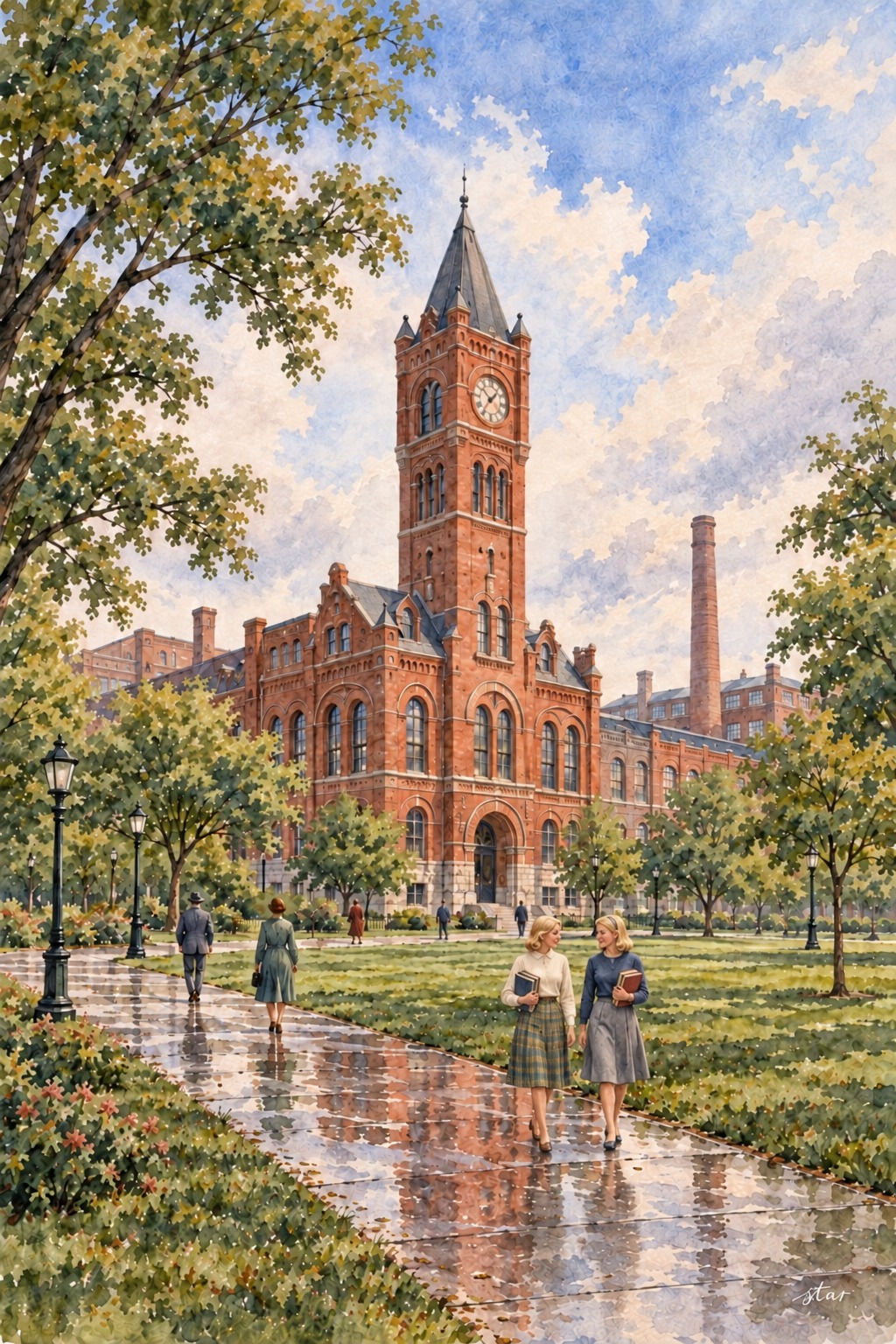
At 610 East 111th Street, a red-brick clock tower stands at the center of a story about more than sleeping cars. The Pullman Administration Building was the public face of a factory and a company town. Its architecture promised order, beauty and modern living. The workers who built the cars experienced something more complicated: their employer could also be their landlord.
Today the building houses the National Park Service visitor center for Pullman National Historical Park. It is a useful place to begin, but the neighborhood around it is not an outdoor museum emptied of residents. Most homes remain private. Understanding that distinction makes a visit more respectful and brings the history closer to the present.
A factory with a landscaped front door
The Pullman Palace Car Company bought 4,000 acres between Lake Calumet and the Illinois Central railroad south of Chicago. Groundbreaking began in spring 1880. Architect Solon Spencer Beman designed the buildings, landscape architect Nathan Barrett shaped the parks and grounds, and engineer Benezette Williams designed the sewage system. The project depended on industrial infrastructure as much as attractive brickwork.
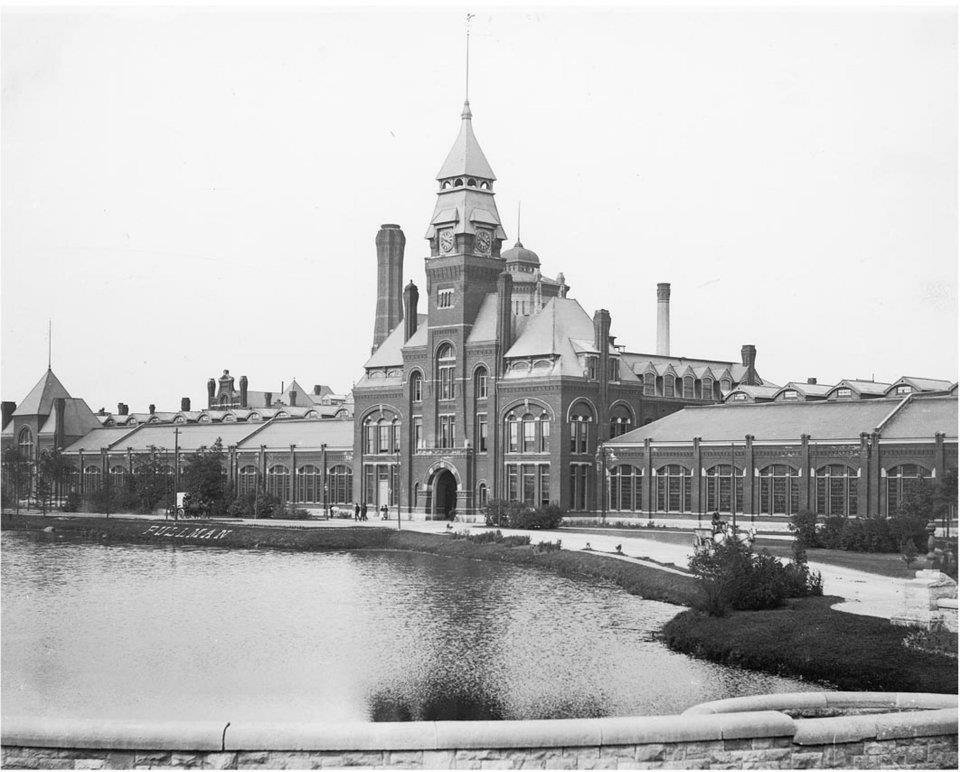
The Administration Clock Tower Building, built in 1880, formed the central mass of a factory composition some 700 feet long. Its main facade faced the Illinois Central tracks, greeting people who arrived by train. Arched openings, a steep tower roof and a carefully ordered frontage gave the works a civic dignity unusual for a manufacturing plant.
Lake Vista in front was both scenery and equipment. The artificial lake served as a cooling reservoir for the great Corliss steam engine. Barrett's curving water and planting softened the factory's repetitive lines, but the picturesque landscape was connected to the machinery behind it. The later filling of the lake and construction of additional tracks changed that original approach.
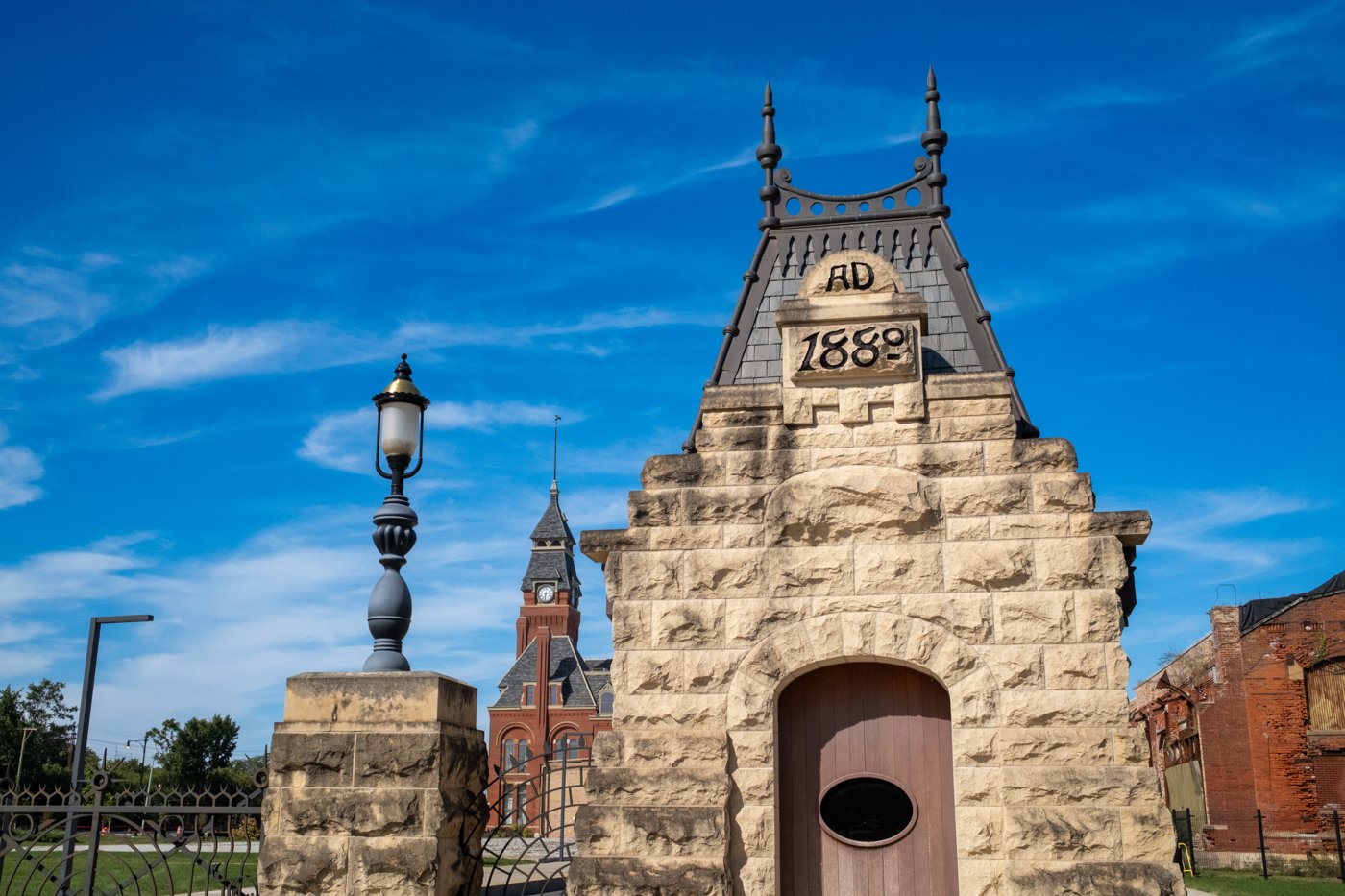
On the surviving frontage, compare the tower's vertical emphasis with the long, lower wings. The repeated windows establish the scale of the factory; the tower gives it a single point of focus. Nearby stone gate structures offer a different texture from the brick walls. These details reward a slow look before entering the exhibits.
Beman's town, not one isolated building
Beman was born in Brooklyn in 1853 and trained in Richard Upjohn's office before moving to Chicago for Pullman's commission in 1879. His work here included the factory, houses, shops and community buildings. Chicago's landmark biography credits him with more than 1,300 houses. He used related materials and proportions without making every block identical.
Queen Anne forms enlivened the houses, while Romanesque arches appeared in buildings for commerce and services. Brick color, rooflines and details provided variety within a coordinated plan. The Hotel Florence, Greenstone Church and worker housing make more sense when read alongside the factory than as unrelated stops on a list.
Beman's career extended well beyond Pullman. His Chicago work included the Fine Arts Building, Kimball mansion and Blackstone Library. He later became an important designer of Christian Science churches. Longyear Museum's account identifies him as associate architect and adviser during the final construction year of the Mother Church Extension in Boston, rather than its sole original designer.
The bargain behind the model town
Pullman offered indoor plumbing, refuse collection and housing that compared favorably with much contemporary industrial accommodation. By autumn 1883 the town had more than 8,000 residents. Many were immigrants, and skilled factory labor was important to the company's success. Women also worked in jobs including sewing. This was a working community, not simply an architectural demonstration.
The advantages were not gifts. Rents were intended to return six percent on the company's investment, and company control limited what residents could do with rented homes. Ownership opportunities, saloons and some religious institutions were available in neighboring communities rather than inside the tightly managed town. Not every factory employee lived in Pullman; some chose or needed to live elsewhere.
The tension was structural. A worker could lose wages without receiving a matching reduction in housing costs. The same company controlled employment and the conditions of domestic life. Contemporary praise for sanitation and design should therefore sit beside the residents' complaints about charges, surveillance and authority, not replace them.
The 1894 strike and national boycott
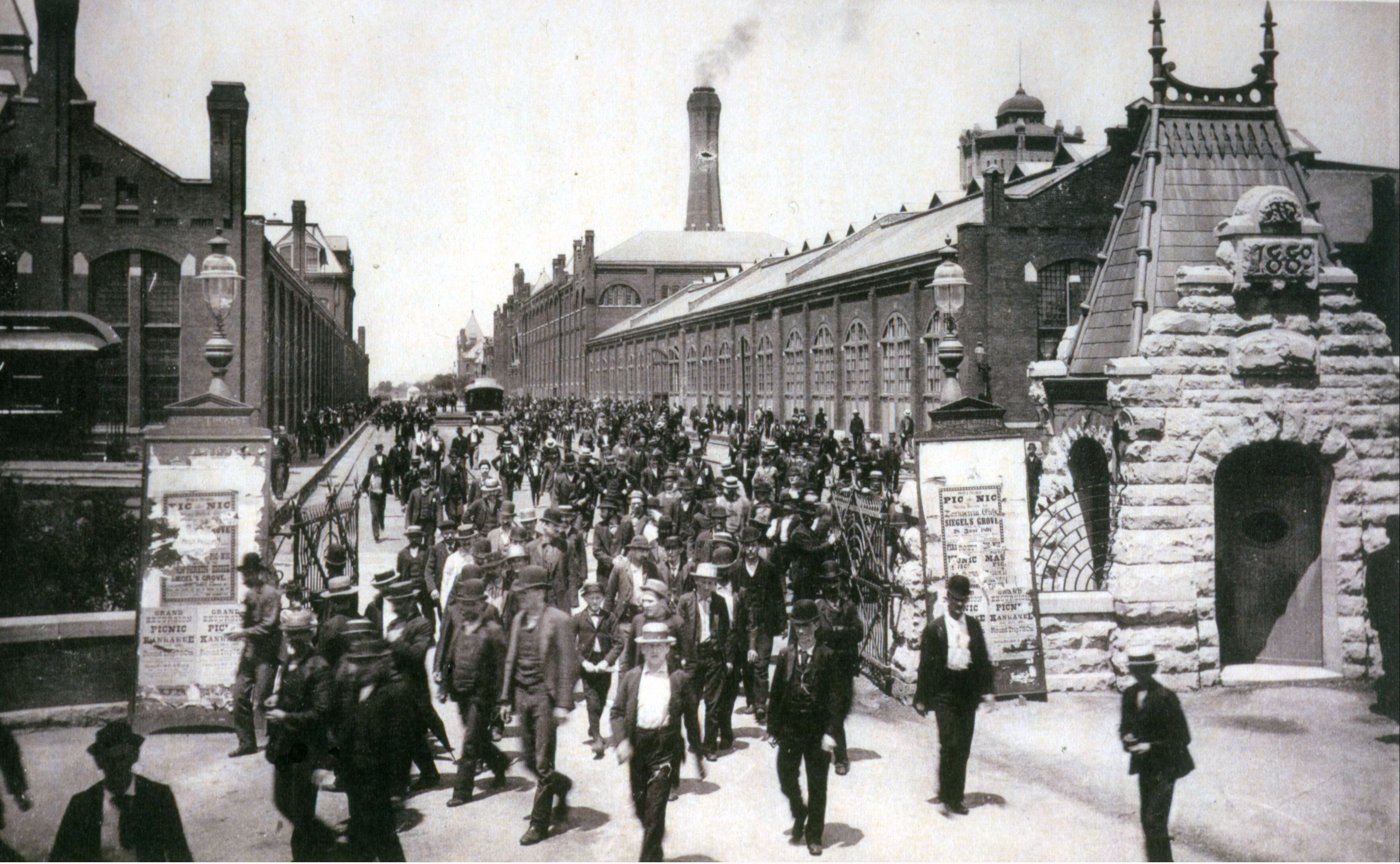
The economic depression following the Panic of 1893 brought wage reductions. Workers' attempts to negotiate with the company failed, and the factory strike began May 11, 1894. Eugene V. Debs's American Railway Union then supported a nationwide boycott of Pullman cars. Because those cars traveled across many railroads, a dispute rooted in one company town disrupted traffic far beyond Chicago.
Railroad managers organized against the boycott, used replacement labor and linked Pullman cars with mail service. Federal authorities obtained an injunction and sent marshals and troops, despite Governor John Peter Altgeld's opposition. Violence at Chicago-area rail yards killed and wounded workers and others. The injunction and imprisonment of union leaders weakened the movement; the national boycott dissolved in mid-July.
The factory strike and national railroad boycott were connected but distinct actions. So were the workers involved. The ARU admitted white railroad workers and excluded Black workers. A history that calls the 1894 action a strike by Pullman porters erases that exclusion and confuses factory employment with the service work performed aboard the cars.
George Pullman resisted arbitration and defended his policies before the commission President Grover Cleveland appointed to investigate. His reputation suffered even though the union lost. After his death in 1897, the company continued under Robert Todd Lincoln. In October 1898, the Illinois Supreme Court ordered the sale of non-industrial land; most of the town's homes changed hands in 1907, with residents given the first opportunity to buy.
The porters' separate struggle
Black Pullman porters helped make the company's luxurious cars comfortable for travelers, while working under discriminatory conditions. Their organizing belongs in this story, but on its own timeline. The Brotherhood of Sleeping Car Porters was founded in New York in 1925 under A. Philip Randolph's leadership.
Its 1937 agreement with Pullman was the first major labor contract between a Black union and an American corporation. The achievement connected workplace organizing with the wider struggle for civil rights. The A. Philip Randolph Pullman Porter Museum is a separate partner destination in the neighborhood, not another room included automatically in a visitor-center tour.
Fire, rescue and a national park
Residents organized against demolition proposals in the twentieth century, and the district became a National Historic Landmark on December 30, 1970. Illinois bought the Administration Clock Tower Building and the 12.66-acre historic site in 1991. An arson fire on December 1, 1998 badly damaged the building; the tower and clock were rebuilt and installed in 2005.
President Barack Obama established Pullman National Monument on February 19, 2015. It is now Pullman National Historical Park. The visitor center opened in the Administration Building over Labor Day weekend in 2021, returning a public use to the restored structure. The brick shell and reconstructed tower tell a preservation story as well as a nineteenth-century industrial one.
Who controls the site now?
The National Park Service operates the visitor center, while the district combines federal stewardship, Illinois historic properties, partner organizations and private residences. The state's 1991 acquisition is well documented; it should not be mistaken for proof that every parcel in today's national park has the same owner. Nor does national-park designation turn occupied houses into public buildings.
The Hotel Florence has a separate redevelopment process. Illinois's published determination for solicitation RFS 2025-01 names Celadon Construction Corporation NFP as the selected contractor for a public-private partnership covering the hotel and annex. It describes a 40-year initial term and possible 35-year renewal. Selection is not evidence that the hotel has reopened, that ownership was sold, or that visitor-center operations have transferred to that contractor.
Pullman on screen
Road to Perdition, released in 2002, used Pullman for scenes set in Depression-era Illinois. The specialist location guide identifies Hotel Florence as the home of Connor Rooney and a Pullman warehouse as the place where Michael Sullivan Jr. discovers his father's work. Tom Hanks and Paul Newman starred in Sam Mendes's film. Those locations do not make the movie's fictional crimes part of the town's actual history.

Visiting and eating nearby
Checked November 9, 2026, the live NPS operating-hours panel lists the Administration Clock Tower visitor center Wednesday-Sunday, 10 a.m.-4 p.m., closed Monday and Tuesday. This differs from an older activity page's daily schedule. Check the operating-hours panel and alerts before traveling, particularly around holidays. Admission to the NPS site is free; separate partner sites may charge.
The guided-tour page advertises 1 p.m. ranger tours, first come, first served, limited to 25 people without reservations. Because that page says daily while the live center schedule has closed days, confirm a tour on your intended open day rather than relying on a Monday or Tuesday departure. Groups larger than 15 should give advance notice. NPS also posts road construction around 111th Street and Cottage Grove, with occasional single-lane access to visitor parking.
For a meal beyond the historic district, Calumet Fisheries at 3259 East 95th Street is a separate South Side stop, not an on-site restaurant or a quick walk from the clock tower. Its direct site lists Sunday-Wednesday 10 a.m.-9:45 p.m., Thursday 9 a.m.-9:30 p.m. and Friday-Saturday 9 a.m.-9:45 p.m. Plan the extra journey rather than treating the visitor center as a dining destination.
Sources
- NPS building history and address
- NPS town planning and residents
- NPS strike and boycott
- NPS Pullman porters
- National Historic Landmark to National Monument
- 2021 visitor-center opening
- Beman city biography
- Beman, Longyear Museum
- Hotel Florence partnership
- Illinois contractor-selection determination
- Road to Perdition locations
- Live operating hours
- Current construction alert
- Guided tour details
- Admission and partner fees
- Calumet Fisheries hours