The London Guarantee Building: An Insurance Palace Above the River That Became LondonHouse
November 4, 2026

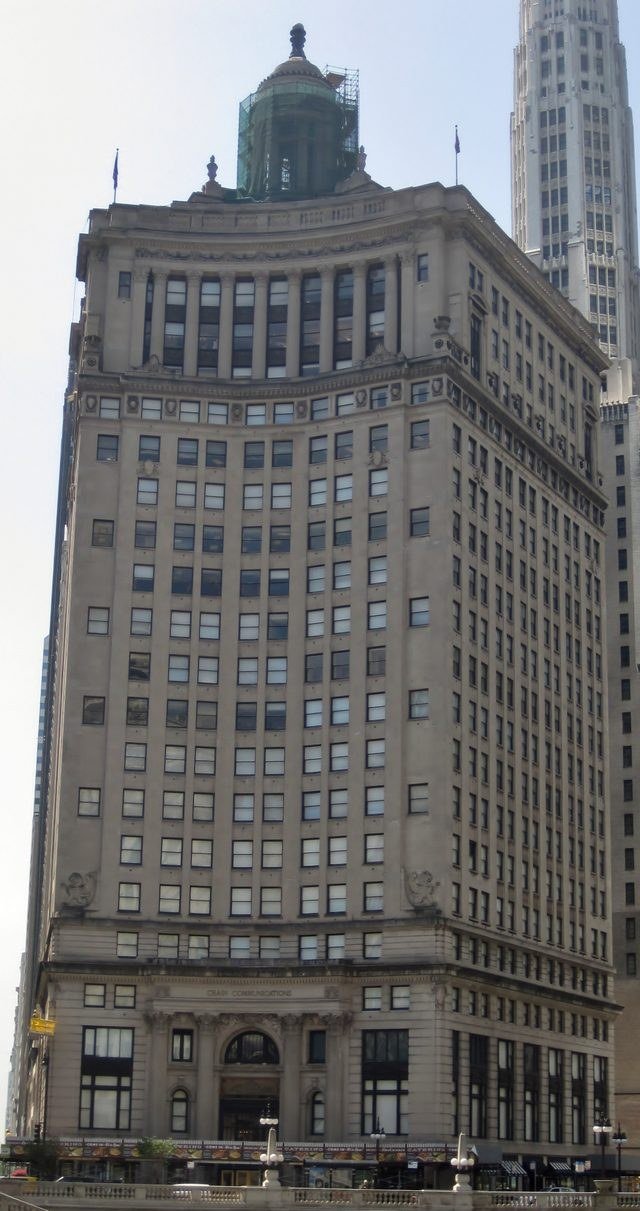
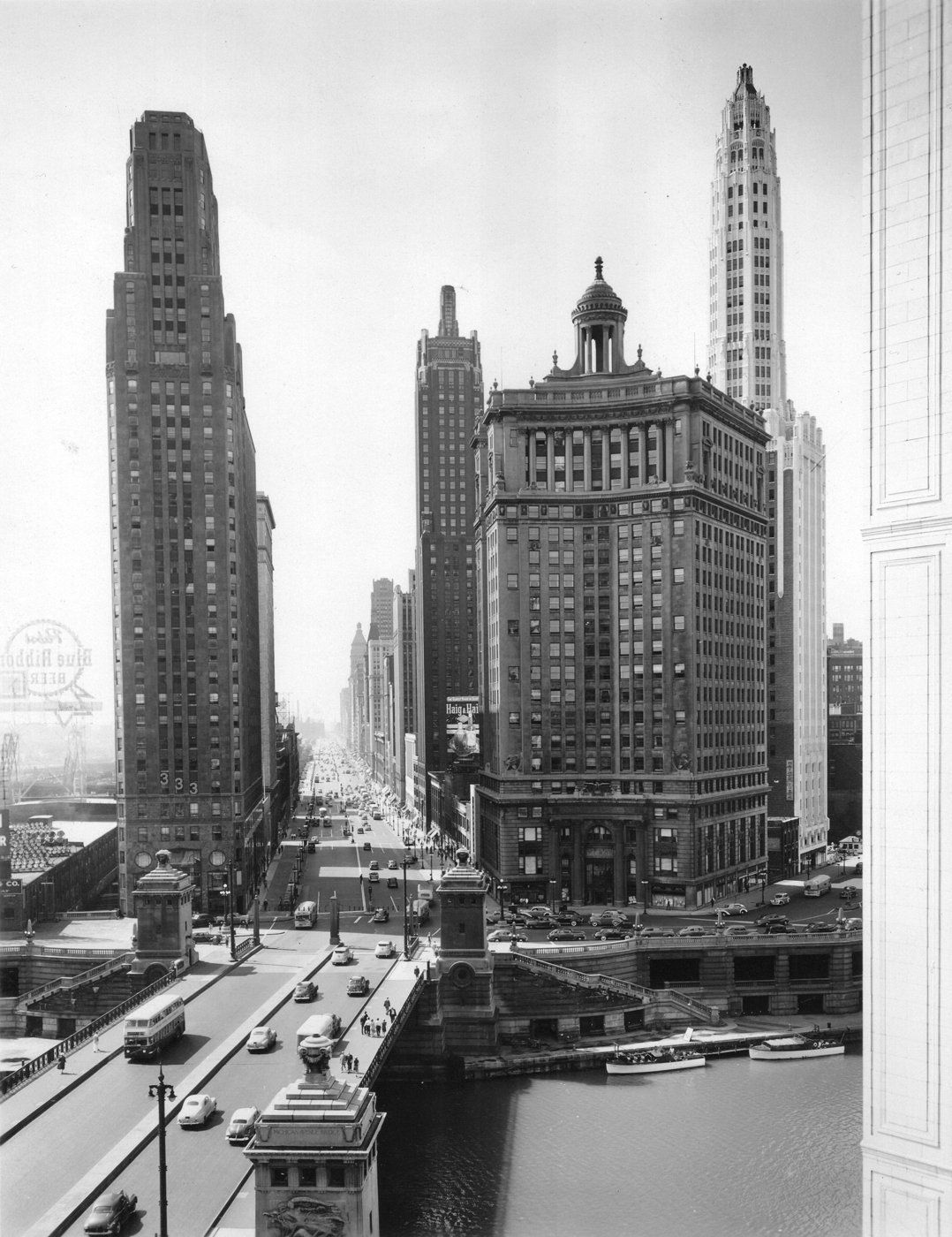
The London Guarantee Building occupies one of Chicago's most conspicuous riverfront corners, where Michigan Avenue meets Wacker Drive. Its round, columned cupola distinguishes it from the Wrigley Building across the river and Tribune Tower and 333 North Michigan nearby. These four 1920s buildings frame the Michigan Avenue Bridge, turning an engineering crossing into a monumental urban space. The former insurance headquarters now contains the LondonHouse Chicago hotel, whose address is 85 East Wacker Drive.
The building's history brings together several different Chicagos: the ground once occupied by Fort Dearborn, the office-building boom after the bridge opened, a celebrated jazz supper club, radio broadcasting and the conversion of older offices into a hotel. The name has changed with tenants and owners, but the curved facade and theatrical roofline have kept their place in the view.
Fort Dearborn and the new boulevard
The city landmark report places the building on part of the land occupied by Fort Dearborn between 1803 and 1856. The original fort was destroyed in 1812 and rebuilt in 1816. That history should not be confused with the age of the present tower, which was constructed in 1922-23. The cornerstone ceremony took place December 3, 1922, with representatives of the Army, city, state, insurance company and Chicago Historical Society.
By then the river crossing had changed the value and visibility of the site. The Michigan Avenue Bridge opened May 14, 1920, helping create a continuous boulevard between the North and South sides. The 1909 Plan of Chicago had called for widening Michigan Avenue and separating different kinds of traffic. The double-deck bridge and street improvements made the area a setting for large commercial buildings rather than merely a difficult river junction.
The London Guarantee and Accident Company commissioned its American headquarters at this new focal point. Its corporate history began in England in 1869 and included accident, fidelity and commercial-credit insurance. The skyline presence was part of the company's public identity: visitors approaching the bridge could see an elaborate building announcing a firm whose work was otherwise conducted in offices.
Alschuler fitted a palace to an awkward site
Architect Alfred S. Alschuler designed a building that was neither a simple rectangle nor a tower seen from only one direction. The Michigan Avenue side follows the north-south street line, while the Wacker side follows the river's southwestward angle. Between them, the principal river-facing wall is slightly concave. This adaptation to an irregular parcel gives the building its broad, embracing appearance from the bridge.
A small piece of land complicated the plan further. An owner initially refused to sell a Michigan Avenue parcel, so Alschuler designed around it, leaving a light court. After the building corporation obtained a 198-year lease to that property, he designed a five-story section that joined the lower facade while leaving the open court above. The visible composition therefore records a real-estate negotiation as well as an architectural decision.
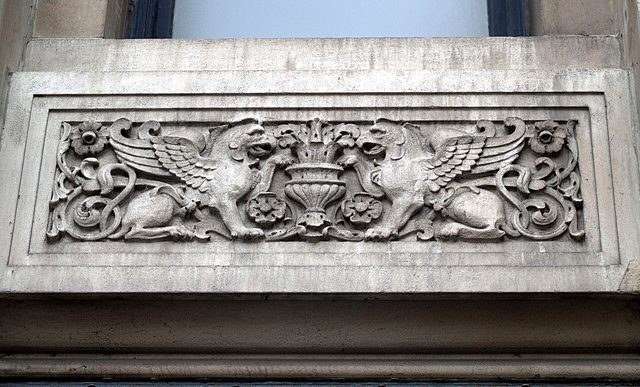
The design uses the classical division of base, shaft and crown. Rusticated masonry emphasizes the lower floors, the middle repeats the office windows, and a colonnade gives the top a different scale. Corinthian columns frame the entrance. Above the roof, the cupola is an open ring of columns under a dome, a conspicuous counterpoint to the Wrigley Building's clock tower. Its effect is easier to understand as part of the riverfront ensemble than as an isolated rooftop ornament.
Alschuler's career included far more than this tower. The Illinois Institute of Technology archives describe his studies at the Armour Institute and the Art Institute, his role in the Armour alumni association and trusteeship, and his involvement with the institution that became IIT. The city report describes a practice spanning industrial, commercial, religious and residential buildings. His commission book contained more than 1,800 job orders from 1908 to 1939. The London Guarantee Building turned that experience with business architecture into an especially public commission.
The building won the 1923 Gold Medal for excellence in design in a competition organized by the Lake Shore Trust and Savings Bank. The jury considered the architecture, the knowledge displayed in its planning and its importance to Chicago's development. The award was therefore recognition of both the detailed design and the building's role in the changing city. A plaque on the northeast corner commemorates it.
A landmark that kept changing
The building was completed in 1923. Later alterations changed the entrance and vestibule without erasing the main architectural composition. The landmark report describes a marble vestibule floor with geometric shapes and a central double star, travertine walls and an elaborate vaulted plaster ceiling. In 1957 a dropped ceiling concealed the vault and dome, and other changes covered the carved building name and removed a decorative eagle.
The report also records a Fort Dearborn bronze relief originally designed for the entrance, later removed and donated to the historical society. Chicago designated the building a landmark on April 16, 1996. Preservation recognized a particular exterior and urban setting while allowing the property to keep finding new uses.
Jazz downstairs, broadcasting upstairs
The London House supper club made the address famous in a different way. George and Oscar Marienthal developed their restaurant business here after taking over the Fort Dearborn Grill in 1946. During the 1950s the room became one of Chicago's leading places to hear jazz while dining. Oscar Peterson, Ramsey Lewis, Marian McPartland, Nancy Wilson and other major performers appeared there; live recordings carried its name beyond Chicago.
Ramsey Lewis's oral history in the Newberry Library's Marienthal Family collection gives a musician's view of the room. He remembered starting as an off-night musician and later headlining with Eldee Young and Red Holt. Three-week bookings in June brought prom and graduation audiences, while December engagements attracted an older crowd. Between sets the musicians met friends and signed autographs. Lewis also recalled listening at the bar to pianists he admired, including Oscar Peterson and Erroll Garner. Staff sometimes quieted noisy tables or asked disruptive patrons to leave, protecting the music as well as the dining experience. The club was a workplace with its own rhythms, not merely a list of famous visitors. It belongs to the building's mid-century history, not the present hotel's rooftop operation.
Radio created another largely unseen audience. WLS had studios in the building, and the hotel records Paul Harvey's syndicated broadcasts from the fourth floor. People who never entered the tower could hear voices transmitted from it. The exterior also became a television location: accounts of Perfect Strangers identify it as the fictional Chicago Chronicle newspaper. Those establishing views do not mean the sitcom's office interiors were filmed inside the real building.
Offices become LondonHouse
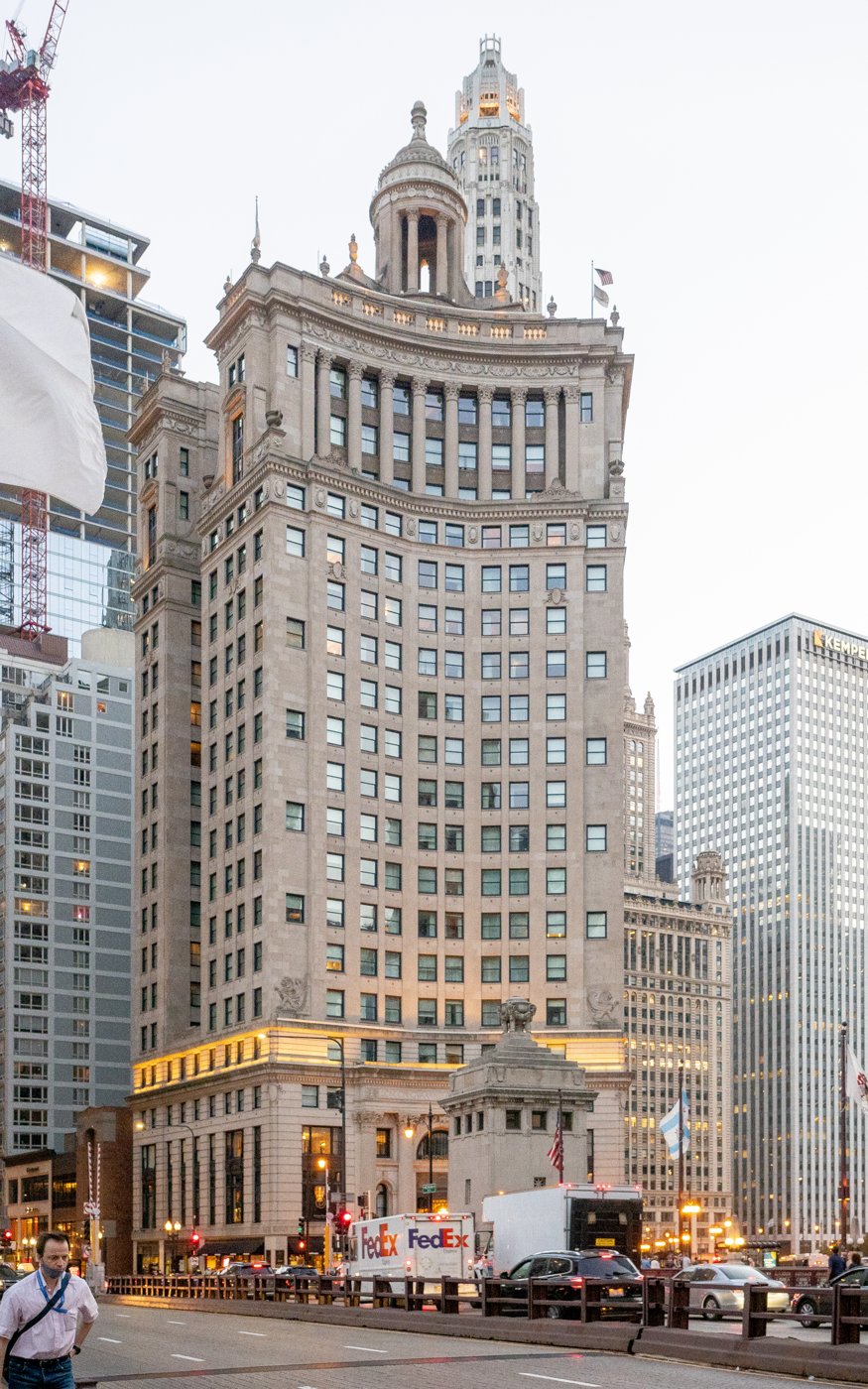
Stone Container's long-term lease in 1960 gave the tower another familiar name. Crain Communications later acquired it, and Oxford Capital Group bought the property in 2013 for redevelopment. The conversion combined the historic tower with a new 22-story glass addition designed by Goettsch Partners. The 452-room LondonHouse opened in spring 2016 under Hilton's Curio Collection flag.
The new building supplied space that the historic parcel could not easily provide on its own. Hotel rooms, meeting areas and social spaces replaced the old office program, while the rooftop became an attraction in its own right. The contrast between the limestone tower and glass addition makes the adaptation visible rather than disguising every modern requirement as 1923 architecture.
Who owns the building today?
The hotel and retail premises must be distinguished. The 2016 transaction announcement describes a $315 million sale of the hotel to Union Investment and a 25-year lease-management-back arrangement with Oxford. The acquisition expanded Union's UniImmo:Europa fund. The Oxford-Angelo Gordon venture retained a separate retail parcel on the first and second floors, rather than keeping ownership of the entire hotel.
In 2023, The Real Deal reported that Starwood Property Trust took possession of the retail parcel through a deed in lieu of foreclosure, citing a filing that dated possession to May. Oxford's current hotel portfolio still lists LondonHouse, and Union maintains a property page for it. These sources support the separate investment, operating and retail roles; they are not a fresh deed or ground-lease search certifying every present legal interest.
Visiting and dining at LondonHouse
The building is an operating hotel, not an unrestricted architectural observation deck. Hilton describes LH's indoor 21st-floor bar, 22nd-floor rooftop and exclusive 23rd-floor Cupola. Check access and reservations with the venue rather than assuming that every rooftop level is open to anyone.
Checked November 9, 2026, the direct hotel page lists LH Rooftop daily 11 a.m.-midnight, with kitchen and bar service until 11 p.m. It also warns of a seasonal transition: before Rudolph's Rooftop launches November 21, outdoor food service is weather-dependent or moved indoors to LH on 21. Bridges Lobby Bar on the second floor lists 11 a.m.-11 p.m. The indoor option matters in November; a rooftop photograph is not a weather or access guarantee.
For a separate meal farther south, The Gage is at 24 South Michigan Avenue, opposite Millennium Park. Its direct kitchen hours are Monday-Thursday 11 a.m.-11 p.m., Friday 11 a.m.-midnight, Saturday 10 a.m.-midnight and Sunday 10 a.m.-11 p.m. These operator hours can change. The hotel itself offers the closest dining choices; the Gage is a different destination along Michigan Avenue, not a restaurant inside this tower.
Sources
- City landmark entry
- City landmark designation report
- Chicago Architecture Center
- Alschuler biography, IIT archives
- Hotel history
- London House jazz history
- Ramsey Lewis oral history, Newberry
- Perfect Strangers exterior account
- 2016 sale and lease announcement
- 2023 retail deed in lieu
- Oxford operating portfolio
- Union Investment property page
- Hilton dining/access
- Current rooftop and seasonal service
- The Gage hours