The Chicago Board of Trade Building: The Art Deco Tower at the End of LaSalle Street
October 28, 2026
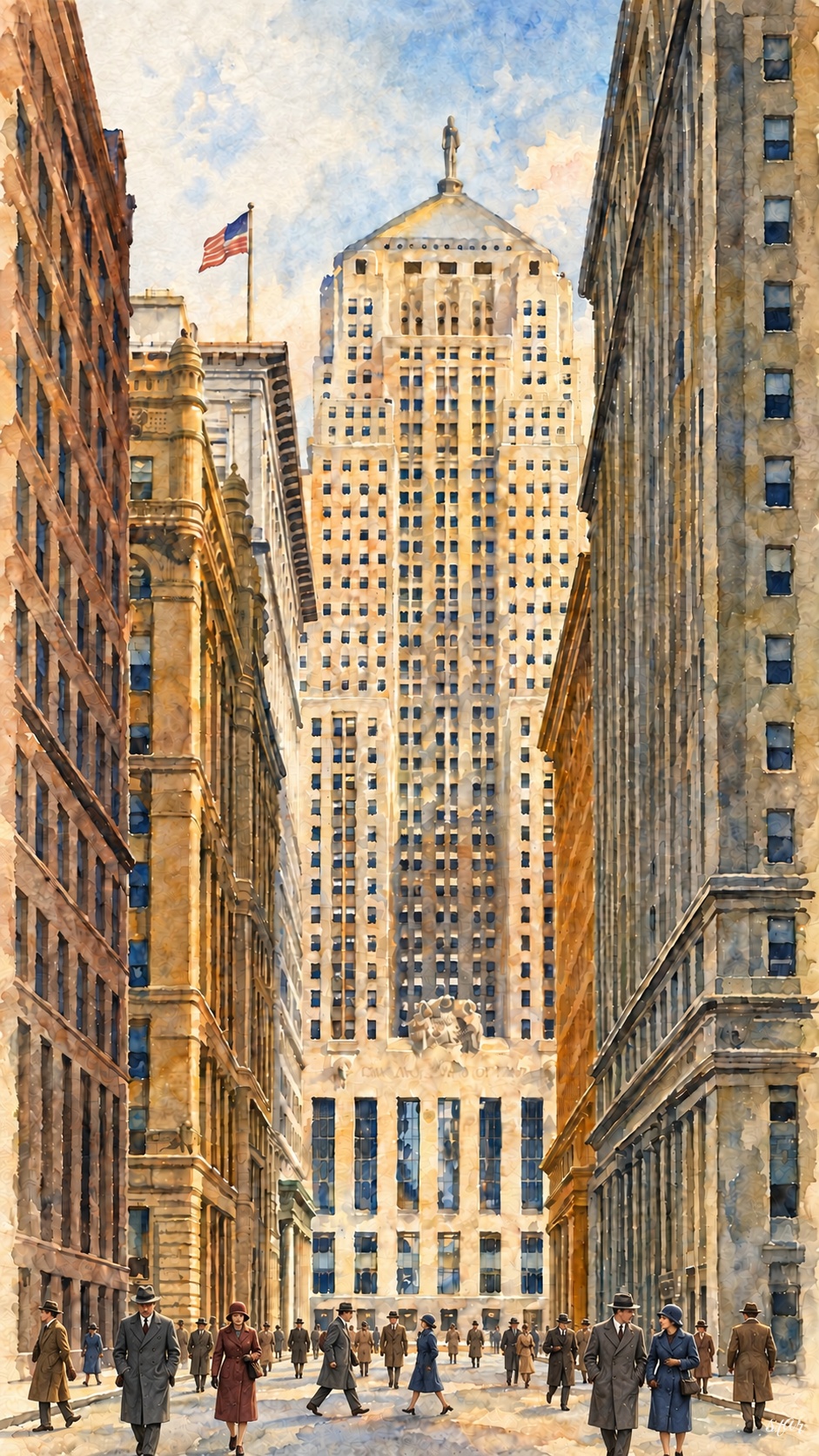
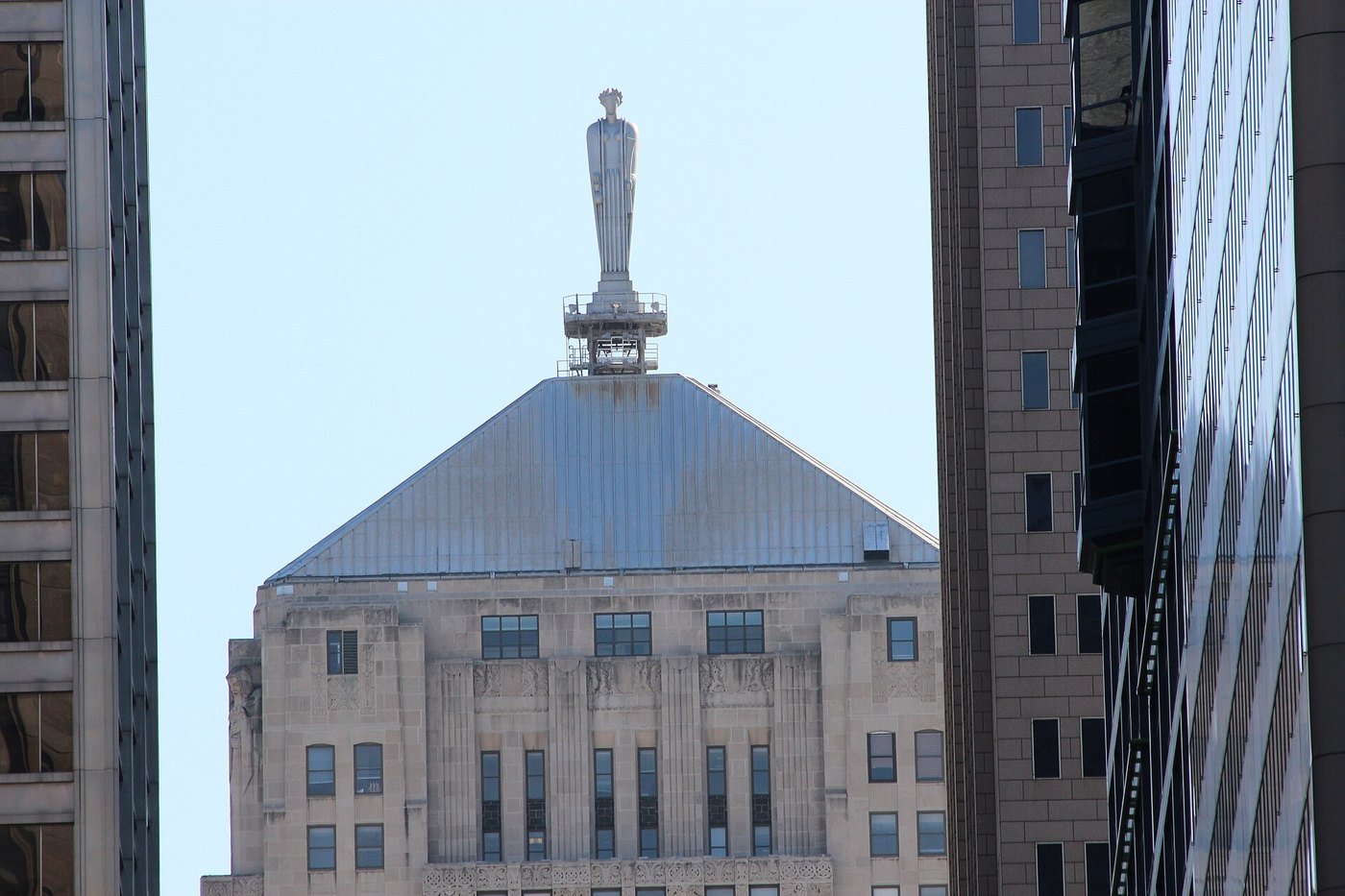
At the south end of LaSalle Street, the canyon of bank and office towers stops at a wall of limestone. The Chicago Board of Trade Building at 141 West Jackson Boulevard rises 44 stories, topped by a pyramid roof and a three-story aluminum statue of Ceres, the Roman goddess of grain. Built in 1930, it was the tallest building in Chicago until the Richard J. Daley Center passed it in 1965, and it was the first in the city to go above 600 feet.
The Board of Trade is older than the building by more than eight decades. It held its first meeting in 1848 in a room above a flour store on South Water Street. The tower most people know today replaced the exchange's 1885 building at this site. This article follows the exchange, its two buildings and the tower's own ownership story, which has been more turbulent than the stone suggests.
A first headquarters with a clock tower
After the Great Fire of 1871, the Board of Trade returned to a rebuilt Chamber of Commerce building at LaSalle and Washington, not this Jackson Boulevard site. In 1882 it began a new headquarters here, designed by William W. Boyington, best known for the Chicago Water Tower. Opening in 1885, its ten-story bulk and clock tower rose about 320 feet. Granite came from Maine. Its electric lighting and height announced the exchange's growing importance.
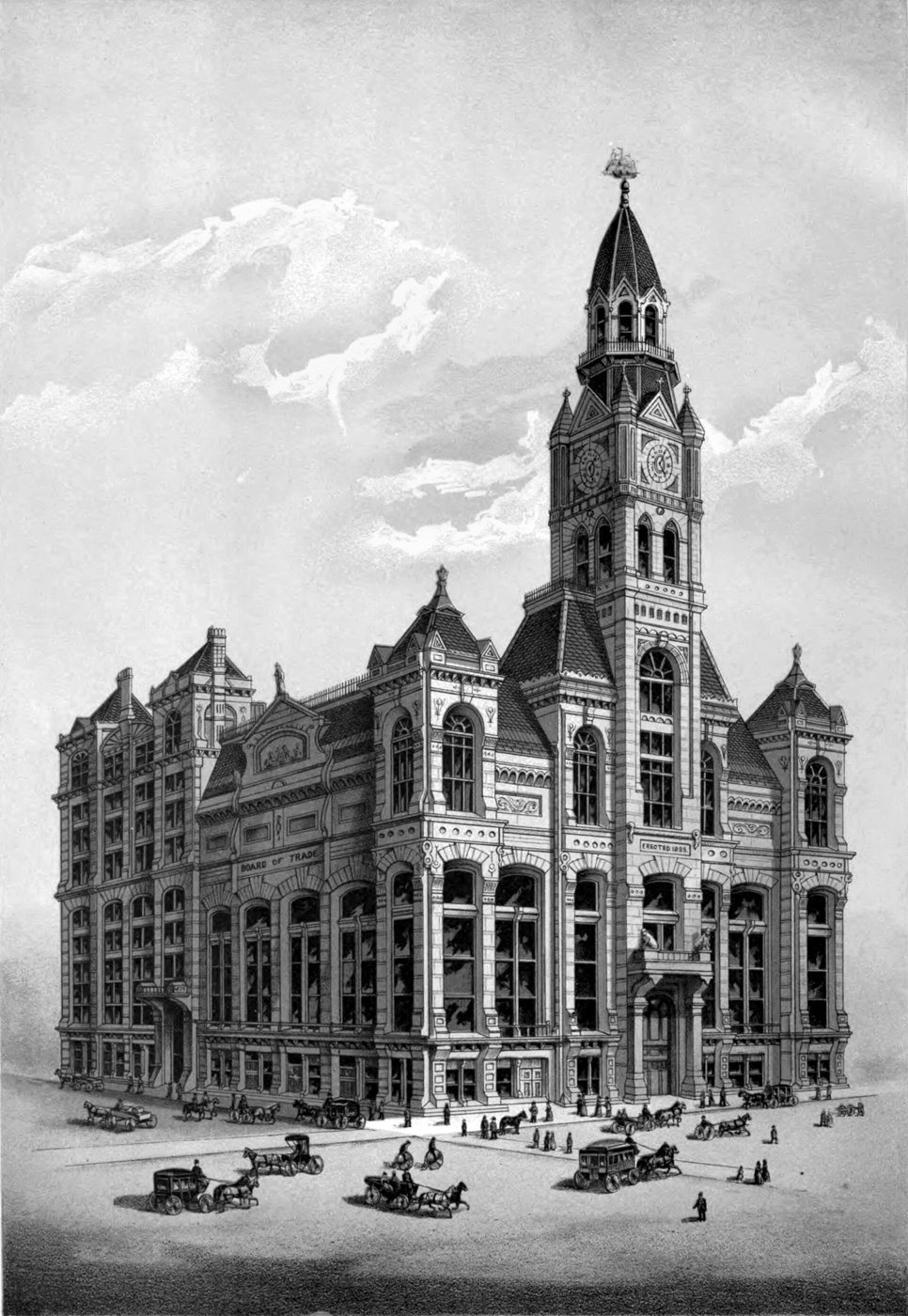
The opening was not purely a celebration. A column of labor activists, led by Albert and Lucy Parsons, marched on the building that evening. The sources describe the new headquarters, which cost about $1.8 million during an economic depression, as a symbol of everything the marchers opposed. Police stopped them blocks from the doors.
The building did not last. It stood on caissons in soft ground, and when construction began across the street on the Federal Reserve Bank of Chicago in the 1920s it became structurally unsound. The 1885 tower was demolished in 1929, and the exchange moved temporarily while a replacement went up on the same corner.
Holabird & Root's tower
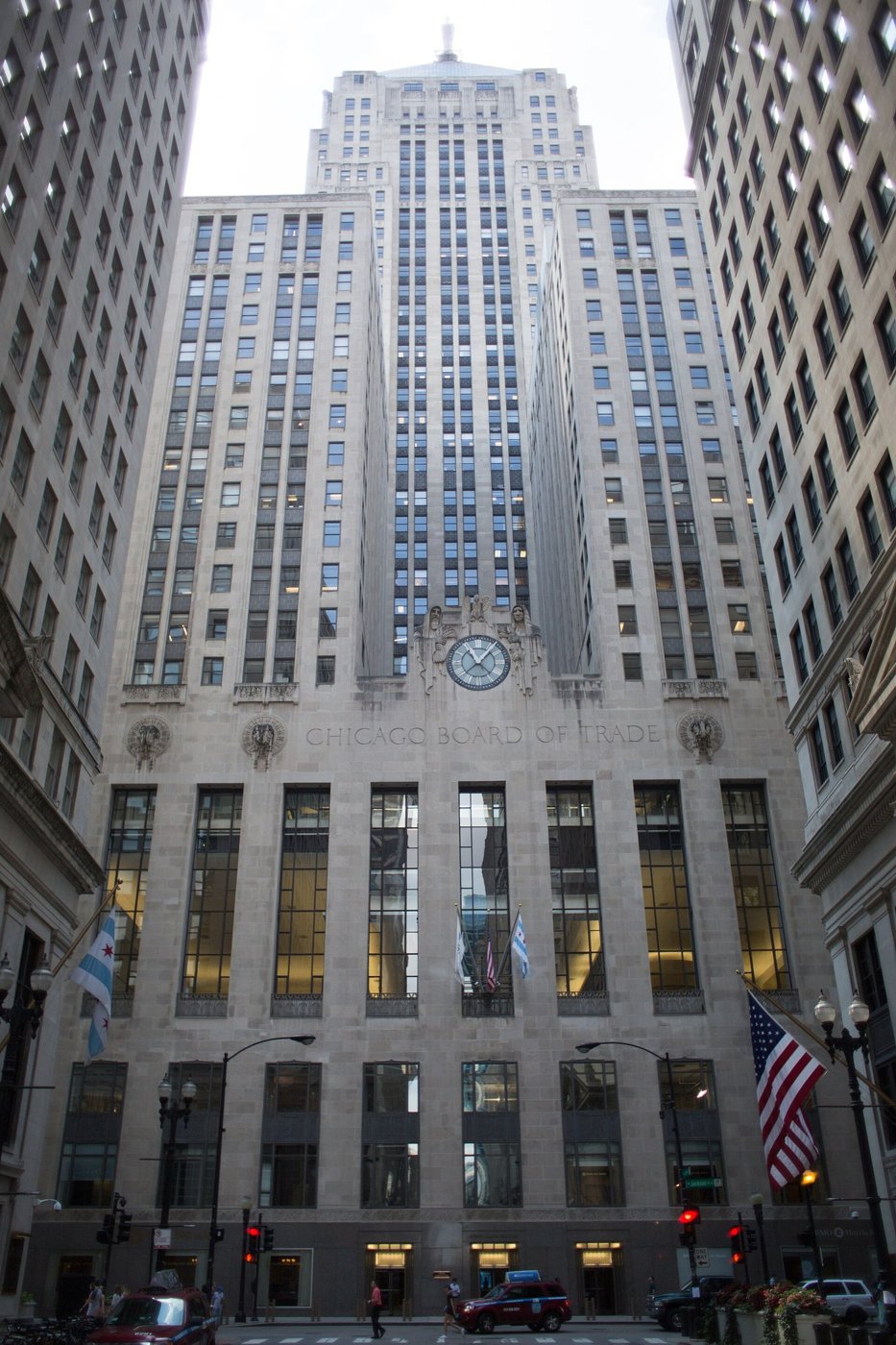
The architectural achievement is partly urban. Rather than disappearing into a continuous row of offices, the tower ends the long view south along LaSalle Street. Its broad lower mass answers the width of the street, while the setbacks draw the eye upward toward the pyramid and Ceres. The Chicago Architecture Center calls attention to the almost vanishing dark windows between pale stone piers. From a distance, the stone seems to organize the whole wall into vertical bands. Closer up, the grain and corn figures explain the business that financed this monumental street ending.
The Board commissioned the successor firm that became Holabird & Root for its new tower in the 1920s. John A. Holabird and John Wellborn Root Jr., not their similarly named fathers, led the practice responsible for the Art Deco building. Costing about $11.3 million, the tower opened June 9, 1930. Gray Indiana limestone piers, deeply recessed dark windows and stepped setbacks give the facade its vertical emphasis. Quaker Oats had already moved in on May 1, before the exchange's official opening.
The sculptor Alvin Meyer, who headed Holabird & Root's sculpture department, covered the facade with figures that tell you what happens inside. A 13-foot clock faces LaSalle Street. On either side of it are hooded figures, a Babylonian holding grain and a Native American holding corn. Higher up, bulls project from the stone, a reference to a bull market.
Ceres, aluminum and 6,500 pounds
The statue on top is by John H. Storrs. The operator identifies it as 31 feet tall and weighing 6,500 pounds. Ceres holds wheat in her left hand and corn in her right, linking the skyline to the exchange's agricultural business. The Chicago Architecture Center describes her simplified, faceless form and machine-like appearance as characteristic Art Deco. The figure is designed to be read at skyline scale rather than as a portrait seen close up.
The pits and the additions
The original trading room was on the fourth floor, directly behind the large windows under the clock, and it was billed at the time as the world's largest trading floor. Traders worked in raised octagonal pits where open outcry set prices. The exchange kept growing. In 1980 a 23-story addition by Helmut Jahn, in black and silver, went up on the south side with its own agricultural trading floor. A five-story addition to the east followed in 1997, which some people nicknamed the "Arboretum" after the exchange chairman Patrick Arbor.
Electronic trading later changed the purpose of these spaces. The historic 1930 trading room was remodeled in 2004, and its former pits were filled, according to the published building history summarized by Wikipedia. CBOT and the Chicago Mercantile Exchange merged into CME Group in 2007. The exchange, the office real estate and the trading technology are therefore separate histories; today's office tower is not a frozen reconstruction of its busiest open-outcry years.
Landmark and restoration
The building became a Chicago Landmark in 1977. In 1978 it was named a National Historic Landmark and listed on the National Register of Historic Places. A $20 million renovation led by the Chicago architect Gunny Harboe in 2005 restored the lobby, upgraded the elevators and cleaned the facade. That same year two granite figures from the 1885 building, Industry and Agriculture, were returned to the plaza in front of the tower. They had been moved to the estate of a wheat speculator in 1929 and were found in a forest preserve in DuPage County in 1978.
Visiting the Board of Trade Building
The address is 141 West Jackson Boulevard. The public building museum is on the first floor near Jackson and LaSalle. Its official page lists free walk-in admission, with no reservation needed, Monday-Friday, 10 a.m.-4 p.m., excluding federal holidays. These details were checked November 9, 2026. The museum opened in 2025; WTTW describes a roughly 2,000-square-foot exhibit with artifacts, video and traders' recorded accounts.
This is an operating office building, not unrestricted public space. Museum visitors undergo security screening. The museum says it is wheelchair accessible and welcomes service animals, but does not supply wheelchairs. Handheld photography is allowed; tripods and lighting equipment are not. Food and drink cannot be consumed in the museum. Its page gives a 49-person capacity and asks larger groups to contact staff about arrangements.
Quincy is a nearby accessible elevated CTA station for Brown, Orange, Pink and Purple Line trains at 220 South Wells Street. Check CTA alerts before traveling. From LaSalle Street outside, the tower's position closing the street view is easier to understand than from directly beneath it. The Rookery, a short walk north, makes a useful architectural comparison.
Famous movies with scenes shot at this building
In Batman Begins (2005), the Board of Trade Building supplies the exterior identity of Wayne Enterprises. Movie-Locations specifically identifies the landmark at the foot of LaSalle Street. This verifies the exterior location, not every fictional office or action scene shown inside Wayne Enterprises. The building also anchors nearby street filming, but a chase on LaSalle Street should not be described as a scene shot inside its tower.
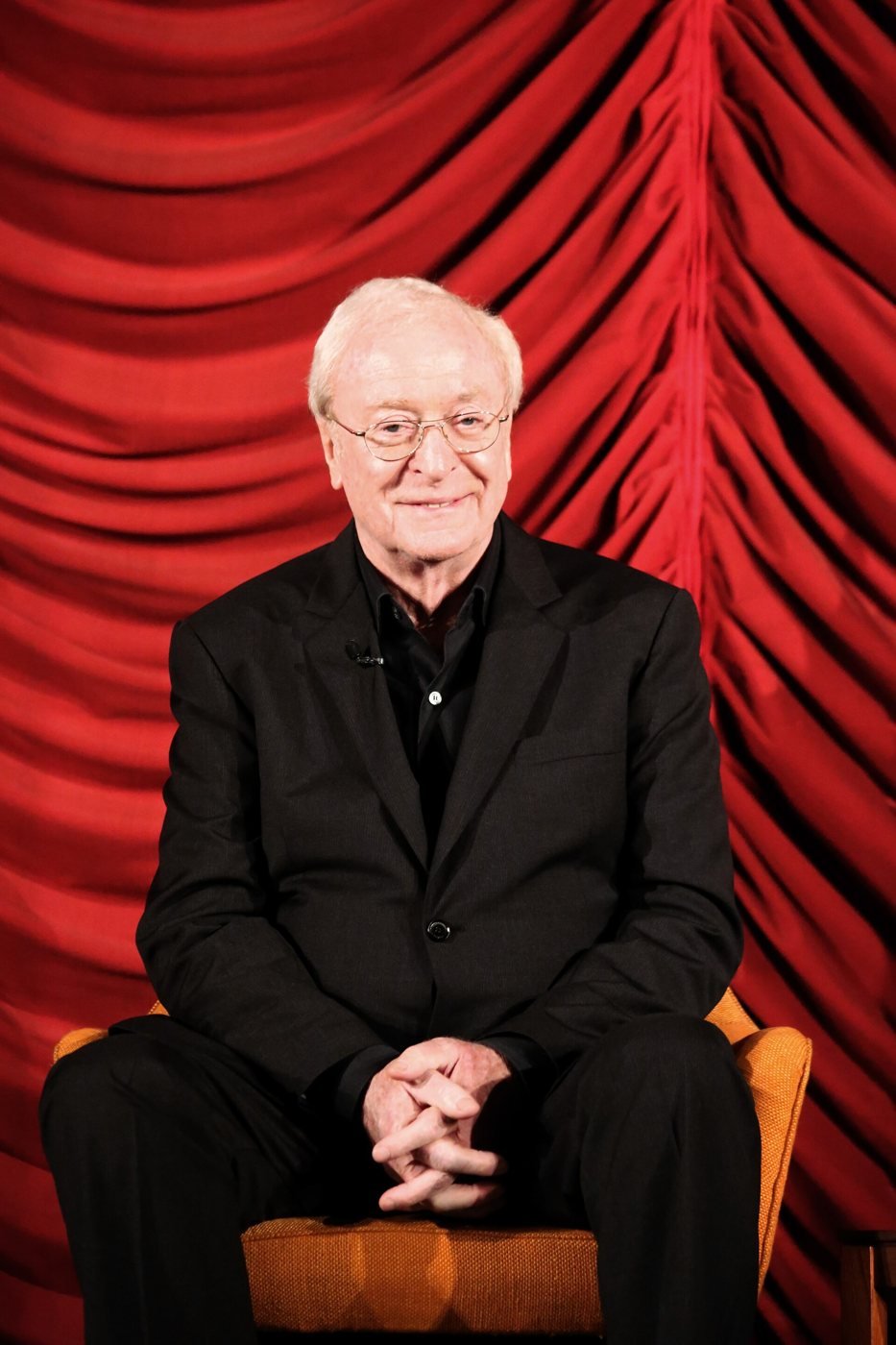
Ferris Bueller's Day Off (1986) also used the exchange: the building's history and Movie-Locations identify the trading-floor visit in which Ferris talks to Sloane while Cameron imitates traders' hand signals. That is separate from the trio's visit to the Sears Tower observation deck. Michael Caine, who played Alfred in Batman Begins, appears in the accompanying 2012 festival portrait; it is not a production still.
Gangsters and Organized Crime
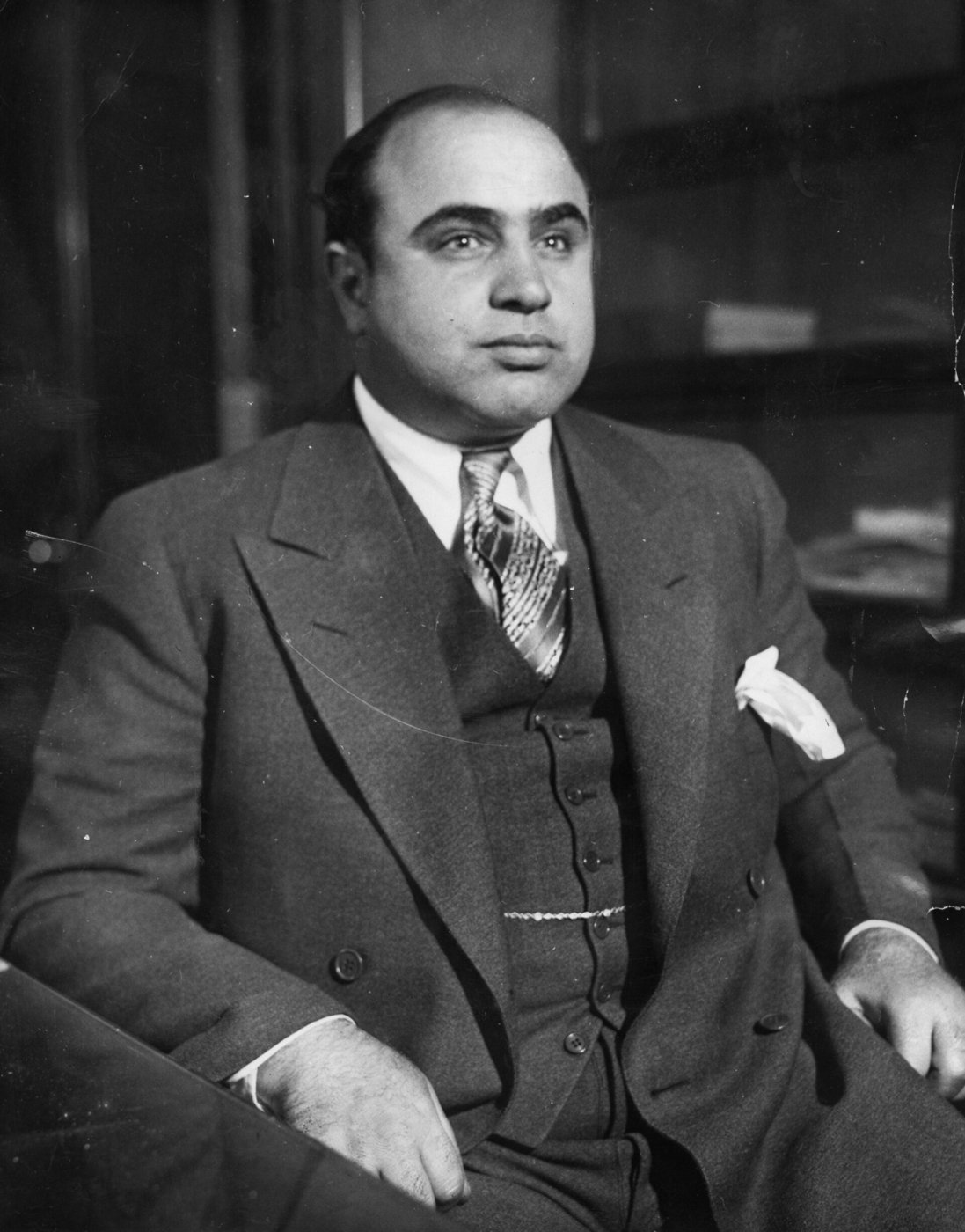
The building's own online history says Al Capone kept a lockbox in its basement vault. The checked sources did not provide the account record or independent contemporary documentation behind that claim. It is presented here as an attributed building story, not proof that the tower was Capone's headquarters. The same timeline mentions the 1986 television opening of a different vault at the Lexington Hotel; that event did not take place here. A 1930 portrait identifies Capone, not the contents or location of a lockbox.
Who owns the Chicago Board of Trade Building today?
CoStar's March 26, 2025 report identifies Athene, associated with Apollo Global Management, as the lender-turned-owner after Glenstar and Oaktree walked away in 2023. It reports a $198 million refinancing loan in February 2020. The exact company on the current deed was not established by this review. Apollo/Athene are the reported investment parties, not a verified transcription of legal title.
R2's current portfolio page says it partnered with Apollo in 2023 to reposition the 1.4-million-square-foot building. CoStar identifies R2 as the local real-estate partner responsible for improvements and leasing activity. Management, investment ownership and the exchange are distinct roles. Older assessor mailing labels are not proof of a current deed holder; neither the land-title structure nor a subsequent transfer was independently established as of November 9, 2026.
Where can you eat or drink at the Board of Trade Building?
Ceres Cafe is in the building's north lobby at 141 West Jackson Boulevard. Its own website now clearly lists Monday-Friday, 7 a.m.-8 p.m. That direct schedule, checked November 9, 2026, replaces the earlier article's reliance on secondary hours and its statement that no hours appeared on the operator's site. Call 312-427-3443 for reservations or holiday changes; no ordinary weekend service is advertised.
The operator traces its service to 1967 and also describes Ceres and Cellars Market on the lower level. The museum lists Cellars, Ceres Cafe, Big Shoulders Coffee and Imee's Kitchen among the building's dining choices. Those are separate businesses with their own schedules, not a promise that every outlet opens throughout museum hours. Eat in the restaurant areas, not the exhibit space.
Sources
- Building operator: history
- Building operator: museum and access
- Chicago Architecture Center: building and architects
- R2: current building portfolio
- Ceres Cafe: direct hours
- CTA: Quincy station
- CoStar: March 2025 ownership and leasing
- City landmark report: history
- Movie-Locations: Batman Begins
- Movie-Locations: Ferris Bueller
- WTTW: museum opens, July 2025
- Wikipedia: secondary historical overview